RS-Key
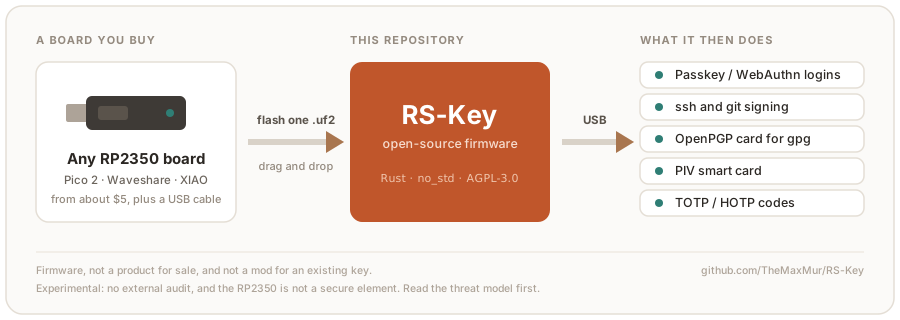
An open-source hardware passkey. Flash one file onto a Raspberry Pi RP2350
board and it becomes a USB security key: passkey logins in the browser, ssh
and git signing, GPG, PIV, and TOTP codes.
| What this is | Firmware. A .uf2 file you drop onto a board. Nothing here is for sale. |
| What you need | Any RP2350 board (from about $5) and a USB cable. No soldering, no programmer, no toolchain. |
| What you get | A USB authenticator your browser, ssh, gpg and ykman already know how to talk to. |
This project is experimental. It has had no external security audit. The RP2350 is not a secure element. A stolen board is only as strong as the optional OTP / secure-boot hardening you have applied to it. Do not use it to guard credentials you cannot afford to lose or have stolen. Read the threat model and limitations before trusting it with anything real.
Written in Rust (no_std, embassy). Under the hood it is
FIDO2/WebAuthn/U2F, an OpenPGP card, PIV, OATH and Yubico-style OTP, plus the
host-side tooling to drive and provision all of it.
Start here
- Quick start: flash a released image, set a PIN, enroll something. No toolchain needed; the images are on the releases page and releases.md says which one to take
- No board yet? The emulator runs the same applet code over sockets, and its
--displaymode opens the trusted screen in a window — the Approve/Deny ceremony can be tried with a mouse before buying anything (testing.md) - Hardware: supported boards and the knobs for them
- Build options: every compile-time flag and environment knob
- Using the device: per-feature guides for FIDO2, SSH, OpenPGP, PIV, OATH, OTP, seed backup, soft-lock, and more
- Production hardening: OTP master key + secure boot (irreversible fuses; read it end to end first)
- Security: threat model, limitations,
and the
unsafeaudit - Project: Contributing · Security policy · Licensing & compliance
What it is, plainly
- It aims to behave like a USB security key and to work with the host software
people already use:
ssh,gpg, browsers, libfido2, andykman(which needs the opt-inVIDPID=Yubikey5build, see below). What has actually been checked on hardware is recorded in the interop matrix, with dates. - It is not a certified hardware security key, and not a drop-in replacement for an audited commercial key in production. There is no secure element.
- The default USB identity is RS-Key’s own (VID
0x1209/ PID0x0001, from pid.codes, the open-source USB VID), presenting as “RS-Key Security Key”. An opt-inVIDPID=Yubikey5build instead borrows a YubiKey’s identity (VID0x1050/ PID0x0407) so thatykmanand Yubico Authenticator (which key off the “Yubico YubiKey” reader name) work without custom rules. That flavor is for interop only and is never distributed. See limitations. RS-Key is not affiliated with or endorsed by Yubico, Nitrokey, or Raspberry Pi.
License
AGPL-3.0-only. RS-Key is a from-scratch Rust reimplementation of the AGPL-3.0-only pico-keys firmware family, so it inherits that license and cannot be relicensed. See NOTICE and COMPLIANCE.md.