OTP fuses (RP2350)
The “production” hardening in RS-Key comes down to writing the RP2350’s OTP: the OTP master key, secure boot, and anti-rollback. This page explains what OTP is, why it is irreversible, how RS-Key writes it, and exactly which rows it touches. Read it before production.md. It is the substrate everything else stands on.
“OTP” here means One-Time-Programmable fuses on the chip, not the Yubico one-time-password feature (guides/otp.md). Different thing, same three letters.
What OTP is
OTP is a block of on-chip memory made of antifuses: writing a bit physically and permanently changes the silicon. A bit goes 0 → 1 and never back. There is no erase, no reset, no “factory default”. For OTP, factory is wherever you left it. Every chip has its own OTP. Nothing about it is shared between boards.
This is the whole point. The value of OTP for a security key is exactly that it cannot be undone: a key fused here can’t be un-fused, a secure-boot bit can’t be cleared, a rollback floor can’t be lowered. Hardening that you could reverse would be hardening an attacker could reverse too.
⚠️ Every write on this page is permanent. A mistake can lock you out of reading a value forever, or brick the board for new firmware. The tools refuse to act without typed confirmations and support
--dry-run. Use it.
Layout: pages, rows, and reliability copies
OTP is addressed in rows (24 bits each), grouped into pages of 64 rows
(so page N starts at row N × 0x40; page 58 begins at row 0xE80). Page
granularity matters because read/write locks are applied per page, not per
row.
A single antifuse can be marginal, so the values that the bootrom and firmware depend on are stored redundantly:
- RBIT-3: the value is written into three consecutive rows, and the reader takes the bitwise 2-of-3 majority. An interrupted burn that set only one copy doesn’t count. Two copies do. The secure-boot flags, the boot-key fingerprints, and the rollback rows are all RBIT-3.
- ECC: other pages store an error-correcting code alongside the data.
Who can write OTP, and when
Two paths write OTP, and the difference is central to how RS-Key stays safe:
- BOOTSEL /
picotool: with the board in BOOTSEL you can read and write OTP directly from the host. This is how the bulk of provisioning happens (the master key, the secure-boot key, the enable bits). - Secure firmware (the rescue applet): a handful of rows must be written by
the running, secure-boot-validated firmware, not from BOOTSEL. Two cases:
- rows that are made bootloader-read-only by a page lock (so BOOTSEL can no
longer write them) but stay secure-writable. The page-58 lock and the
ROLLBACK_REQUIREDflag are applied this way, byrsk otp lock-page58/rsk otp rollback-require, each guarded by an exact magic payload so a stray APDU can never trigger them.
- rows that are made bootloader-read-only by a page lock (so BOOTSEL can no
longer write them) but stay secure-writable. The page-58 lock and the
Each OTP page lock is a byte encoding three independent levels: LOCK_BL
(bootloader), LOCK_NS (non-secure), LOCK_S (secure), each of read-write /
read-only / inaccessible. That three-way split is what lets a page be
unreadable to BOOTSEL but still readable/writable by secure firmware (see
page 58 below).
What RS-Key burns
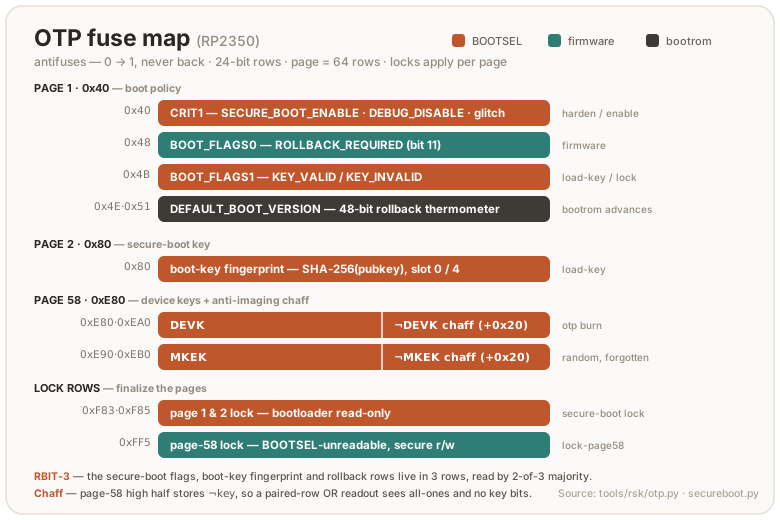
These are the rows RS-Key provisions, grouped by the stage that writes them. The
authoritative source is the code (tools/rsk/otp.py, tools/rsk/secureboot.py,
crates/rsk-rescue/src/rollback.rs). The table is the map.
| Region | Rows | What it holds | Written by |
|---|---|---|---|
| Page 58 | 0xE80… | DEVK (device attestation key), MKEK (master sealing key), anti-imaging chaff | rsk otp burn (BOOTSEL) |
| Page-58 lock | 0xFF5 | makes page 58 BOOTSEL-unreadable, secure read/write | rsk otp lock-page58 (firmware) |
| Boot key | 0x80… | SHA-256 fingerprint of your secure-boot public key (slot 0 of 4) | rsk secure-boot load-key <otp.json> |
BOOT_FLAGS1 | 0x4B | KEY_VALID / KEY_INVALID (which key slots are live / revoked) | load-key, lock |
CRIT1 | 0x40 | SECURE_BOOT_ENABLE, DEBUG_DISABLE, GLITCH_DETECTOR_ENABLE/SENS | harden, enable |
BOOT_FLAGS0 | 0x48 | ROLLBACK_REQUIRED (bit 11) | rsk otp rollback-require (firmware) |
DEFAULT_BOOT_VERSION | 0x4E, 0x51 | the 48-bit rollback thermometer (two 24-bit rows) | the bootrom, on boot |
| Page 1/2 locks | 0xF83, 0xF85 | make the flag + key pages bootloader-read-only | rsk secure-boot lock |
A few notes that matter:
- Page 58 is read-write to secure firmware even after the lock. The lock
value (
0x3C3C3C) sets BL and NS to inaccessible but leaves S read-write. So only secure-mode firmware can ever read the MKEK/DEVK again, and a BOOTSEL flash dump cannot. - The MKEK/DEVK are generated randomly and forgotten.
rsk otp burndoes not keep a copy. The fuses are the key. There is nothing to back up and nothing to lose. - The rollback thermometer is advanced by the bootrom, not by a host write, when a higher-version image boots. See anti-rollback.md.
- Pages 1 and 2 stay bootloader-read-only after
lock(0x141414), not inaccessible. The bootrom must read the keys and flags on every boot. They remain secure-writable, which is how the firmware appliesROLLBACK_REQUIREDafter the pages are otherwise locked down.
Anti-imaging chaff
Page 58 stores the keys in its low half and the bitwise complement of
every key row in its high half: DEVK at 0xE80…0xE8F with its complement at
0xEA0, MKEK at 0xE90…0xE9F with its complement at 0xEB0 (offset 0x20 =
half a page). The firmware never reads the high half. It plays no part in key
reconstruction (firmware/src/otp_keys.rs reads only the key rows). It exists for
one reason.
The cheapest invasive OTP read demonstrated against this antifuse family
(IOActive, RP2350 Challenge 1, see threat-model.md) recovers
the bitwise OR of two physically paired bitcell rows, not the rows
individually. Raspberry Pi’s mitigation is to put the key in one half of a page
and its complement in the opposite half, so each physical pair reads
OR(b, ¬b) = 1, a uniform all-ones pattern that carries no key bits. The
low-half / high-half placement here is exactly that scheme, and it neutralises the
demonstrated readout.
This defeats the demonstrated OR-read. IOActive note that a more advanced attack might separate the paired (even/odd) rows with additional effort, which would read the key half directly, and a plain complement does not stop that. Raspberry Pi have said a forthcoming application note will describe a storage scheme mitigating both the current attack and that hypothetical one. If it prescribes more than complement-in-opposite-half, revisit this.
Reading OTP
OTP is readable until a lock says otherwise:
rsk secure-boot status        # decodes the secure-boot + rollback rows for you
picotool otp get -r -n 0x48   # raw row read (BOOTSEL), if you want the bytes
rsk inventory list / rsk status surface the human-readable state. Once page
58 is locked, picotool otp get on it fails with a permission error forever.
That failure is the lock working, not a fault.
Honest limits
- OTP is not a secure element. It hardens against software- and BOOTSEL-level attacks, and the anti-imaging chaff above neutralises the demonstrated passive-voltage-contrast OTP readout. But the antifuses are still on a general-purpose die: a funded lab with a focused ion beam can image them, and that (like laser fault injection and power/EM analysis) is out of scope (threat-model.md). The antifuse readout is not fixed by any silicon stepping. Use A4 for the fault and boot-ROM fixes (our own boards are A2, the stepping broken in the public challenge).
- It is finite. The rollback thermometer is 48 bits for the board’s life. There are 4 key slots. Neither resets. See anti-rollback.md.
- It is per-chip. None of this carries to another board. A new board is a fresh, blank OTP.