RS-Key host protocol reference
This document specifies the host-facing protocol of the RS-Key firmware: how a configuration/management tool talks to the device, what commands exist, the exact byte layout of each request and response, and what authenticates each one.
It exists so that third-party tooling (e.g. PicoForge) can configure and
manage RS-Key devices without reverse-engineering the firmware. The canonical,
runnable reference client is the rsk Python CLI. Every command
below is implemented there; file/line pointers are given throughout.
Audience & scope. This is a wire spec, not a tutorial. It documents the commands a host sends and the bytes it gets back. It does not cover the on-device storage format, the crypto internals, or the build system. Those live in architecture.md and the crate sources.
Licensing. RS-Key firmware is AGPL-3.0-only. This protocol description is published as part of the same repository; you are free to implement a client against it under any license. Interop implementations do not inherit AGPL by talking to the device.
Stability. The two transports and the standard applets (FIDO2, U2F, PIV, OATH, OTP, OpenPGP, Yubico Management) are stable. They follow public specs. The RS-Key-specific surface (Rescue applet, Vendor/LED applet, CTAPHID
authenticatorVendor 0x41) is versioned bybcdDeviceand may grow; new tags/subcommands are added, existing ones are not silently repurposed. Probe the version handshakes (§3, §6.1) and treat unknown tags as skippable.
1. Transports
RS-Key is a USB composite device exposing two host-reachable transports:
| Transport | Carries | Host API |
|---|---|---|
CTAPHID (FIDO HID, usage page 0xF1D0) | CTAP1/U2F, CTAP2, and the authenticatorVendor 0x41 vendor command | hidapi |
| CCID (PC/SC smart-card) | All ISO-7816 applets, selected by AID | pyscard / PC/SC |
A keyboard (HID) interface also exists for Yubico OTP. On the default build it
also carries the ykman OTP-HID admin writes (SET_DEVICE_INFO 0x15,
DEVICE_CONFIG 0x11, SCAN_MAP 0x12, NDEF 0x08/0x09) — ungated, like a stock
YubiKey; strict-config refuses them. SET_DEVICE_INFO shares the same
EF_DEV_CONF DeviceInfo store as the CCID WRITE CONFIG (§6); the rest are inert
on this USB-only board except SCAN_MAP (it remaps typed OTP output). Each admin
write advances the status frame’s program-sequence byte — that increment is
how ykman/yubikit confirm it (a write that left the sequence unchanged reports
CommandRejectedError: No data, which is what blocked ykman config usb over
this transport before). The frame codec itself is otherwise out of scope here.
The interfaces are presented in the stock YubiKey order — keyboard/OTP, FIDO
HID, CCID — because some hosts address the OTP interface by index instead of
by descriptor: the libusb backend ykpers/ykcore ships (KeePassXC,
ykchalresp, pam_yubico) claims interface 0 and sends the OTP frame reports
there whatever the descriptors say. An interface switched off in
ENABLED_USB_ITF (§7) is omitted and the rest keep that relative order, so a
host that assumes a fixed index only holds where the same interface set is
enabled.
The OTP frame protocol answers a HID feature GET/SET_REPORT on the keyboard
interface only. The keyboard interface being first (index 0) is what those
index-addressing hosts need; serving the frames on the FIDO interface too was
tried but reverted (audit run-30) — it gained no host that the keyboard interface
does not already serve, and on macOS it removed a real privilege boundary (IOKit
gates a keyboard-usage HID nub behind Input Monitoring while the 0xF1D0 FIDO nub
opens to any console-user process). The FIDO interrupt endpoints carry CTAPHID and
nothing else, and its report descriptor declares no feature report.
A slot programmed to require a touch answers its challenge only after a button
press, and reports the wait in the status byte (0x20) meanwhile. Two things end
that wait early, both matching a YubiKey: the host’s dummy write — a report
whose sequence byte is out of range, 0x8f, which also resets the read mode after
a response — and any new frame, which supersedes the pending challenge. A host
that does neither waits out the touch timeout (§7 PRESENCE_TIMEOUT), during
which the transport reports only that it is waiting.
Once announced, 0x20 holds for the rest of the command — the press itself does
not clear it, only the response frame or the idle status frame does. ykpers reads
a byte carrying neither the pending nor the waiting bit as a touch timeout, so a
device that dropped the wait between the press and its answer would lose
challenges it had in fact completed.
1.1 CCID APDU framing
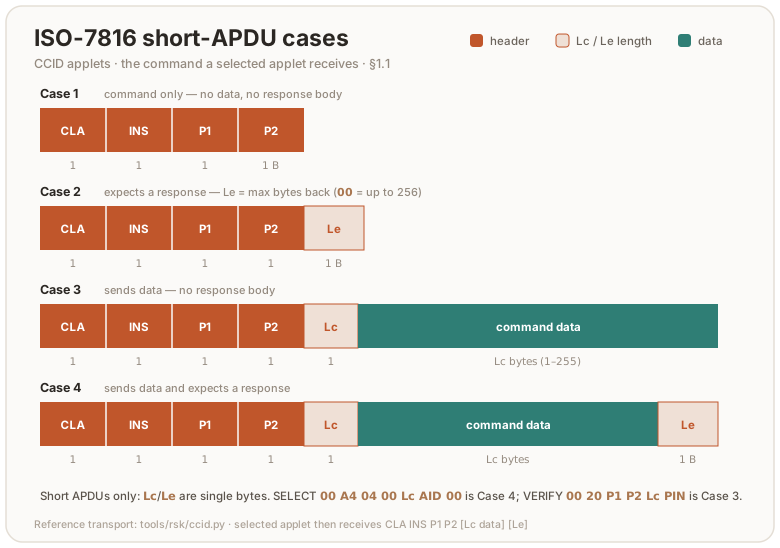
Standard ISO-7816 short APDUs. SELECT is always 00 A4 04 00 Lc <AID> 00; the
selected applet then receives CLA INS P1 P2 [Lc <data>] [Le]. There is no ISO
master file, so the master-file SELECT (00 A4 00 0C …, GnuPG’s 3F00 probe)
answers 6D00 like a YubiKey. The power-on ATR is T=1, its historical bytes labelled
YubiKey on a Yubico-identity build and RS-Key on the default build (identical
card capabilities). The reference transport is tools/rsk/ccid.py:
def select(conn, aid):
    return transmit(conn, [0x00, 0xA4, 0x04, 0x00, len(aid)] + list(aid) + [0x00])
The class byte is judged before the command, for every applet and for SELECT
itself. Bit 0x10 marks a command-chaining segment and is looked at first, so
10, 1C, 90 and FF are all ordinary segments. Otherwise a class carrying a
secure-messaging indication (CLA & 0x0C: 04, 0C, 84, 8C, …) answers
6E00 — no applet here implements secure messaging, and OpenPGP’s Extended
Capabilities says so. Applets that additionally name a class of their own reject
anything else themselves (OATH, management, OTP and U2F want 00; rescue wants
80). A chain is reassembled into a single command of at most 2038 bytes
(one CCID frame); a segment that would reach or pass that is 6700, and the
partial chain is dropped rather than dispatched — so a host that retries the
segment is starting a new chain, not continuing the old one.
A success body longer than the request’s Le (including a Case-3 command that
carries no Le at all, capped at 256) is returned with ISO-7816 response
chaining: the first chunk ships with status 61 XX (XX = further bytes
available, 00 = 256+), and the host issues GET RESPONSE (00 C0 00 00 <Le>)
until 9000. Any GET DATA reading a certificate object over 256 bytes chains
this way, so a host that sends GET DATA without an Le must still follow 61xx.
OATH LIST (0xA1) and CALCULATE ALL (0xA4) responses that outgrow one
frame chain the YubiKey-OATH way instead: 61 XX followed by SEND REMAINING
(00 A5 00 00) rather than GET RESPONSE, matching what ykman / Yubico
Authenticator send. A host that stops at the first frame still sees a valid
(shorter) list.
Seven OATH rules a host has to expect, all matching a YubiKey 5.7.4. PUT
(0x01) is strict about the credential body — KEY TLV 16..=66 bytes, digits
6/7/8, type 0x10/0x20, algorithm 1/2/3, name 1..=64 bytes, the initial moving
factor on HOTP only and exactly 4 bytes, the PROPERTY byte as the bare 78 vv
pair, the four YKOATH tags in that order, no duplicate, no unknown tag and no
trailing byte. Anything else is 6A80 with nothing stored, so a rejected
PUT leaves an existing credential of that name working. (RS-Key also stores the
password-safe fields 0x83/0x84/0x85, ≤255 bytes each, which may sit
anywhere in the body.) SET CODE (0x03) holds its key to the same measured
rule: the 73 TLV is one algorithm byte plus 14..=64 bytes of key material,
or empty to remove the access code — anything else is 6A80 and whatever code
was installed is left exactly as it was. Its proof travels over an exactly
8-byte 74 challenge (os.urandom(8), as ykman sends it); any other width is
6A80, and removing a code needs no challenge at all. VALIDATE (0xA3) then
refuses a proof that does not match with 6A80 as well; 6984 from it means
something else entirely — no access code is installed to match against. And
PROPERTIES bit 0, only increasing, is enforced: a TOTP credential carrying it
computes only for a challenge strictly greater than the highest one it has served,
comparing the raw challenge bytes zero-extended on the right — plain numeric >
for the usual 8-byte counter. A challenge at or below that mark is 6A80, and
in CALCULATE ALL one such credential fails the whole command with an empty
body. The one exception is a credential a build before this rule stored: its
body can leave no room for the mark, and CALCULATE ALL then reports it with
77 (no response) and computes the rest of the store rather than failing — its
own CALCULATE still answers 6A80.
The fourth is the challenge itself. CALCULATE (0xA2) and CALCULATE ALL
(0xA4) take an opaque byte string of 0..=64 bytes in the 74 TLV and HMAC
all of it; 65 or more is 6A80, judged before the credential is looked up and
whatever the credential’s type, so a HOTP account that ignores the challenge
refuses an over-wide one too. Both read paths therefore answer the same code for
the same challenge at every accepted width — including across a SEND REMAINING
page — and the usual 8-byte TOTP counter is simply the common case.
The fifth is how the bodies are read. CALCULATE, VALIDATE and SET CODE
are parsed by position: exactly the documented TLVs, in the documented
order, with nothing before, between or after them — 71 then 74 for
CALCULATE, 75 then 74 for VALIDATE (the response comes first, as
ykman sends it), 73 then 74 then 75 for SET CODE, or a lone 73 00 to
remove the code — that spelling and no other, so a SET CODE carrying no body
at all is 6A80 and the standing code goes on opening the applet, as on a
YubiKey. A reordering, a repeated tag, an unknown tag or a trailing byte is
6A80, with nothing stored. CALCULATE ALL is the one exception the card
makes: its 74 must be the first TLV, and whatever follows it is ignored.
The sixth is what a truncated response carries. With P2 = 0x01 the 76 TLV is
[digits][code(4)], and the four bytes are the RFC 4226 dynamic truncation
already reduced to that credential’s digit count — big-endian, so a 6-digit
account never exceeds 000F 423F. A host must not reduce a second time expecting
a different answer, and VERIFY CODE (0xB1) compares exactly the value
CALCULATE sent. The untruncated form (P2 = 0x00, tag 75) is unaffected: it
carries the whole HMAC.
The seventh runs across the whole table: the parameter bytes. Every OATH command
is sent P1 = 00, P2 = 00. The 01 that selects the truncated form belongs to
CALCULATE and CALCULATE ALL and to nothing else — on PUT, DELETE, SET CODE, RENAME and LIST it is refused like any other stray byte. RESET alone
takes DE AD, and VALIDATE is the card’s own exception: it refuses only when
both bytes are non-zero. Anything else is 6B00, judged before the
command’s body and before the access-code gate so nothing is written; an
instruction the applet does not implement still answers 6D00 first.
1.2 CTAPHID framing
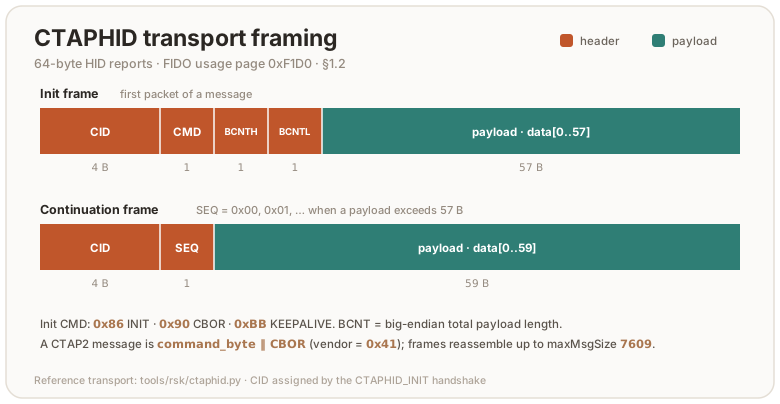
64-byte HID reports. Init frame: CID(4) | CMD(1) | BCNT_HI | BCNT_LO | data[:57];
continuation frames: CID(4) | SEQ(1) | data[:59]. CTAPHID_INIT = 0x86,
CTAPHID_CBOR = 0x90, CTAPHID_KEEPALIVE = 0xBB. A CTAP2 message is
command_byte | CBOR_payload. Reference: tools/rsk/ctaphid.py.
Take the channel id from the CTAPHID_INIT response and use that one: every INIT on
the broadcast CID allocates a fresh id, so an id hardcoded or cached across sessions
will not be yours. CTAPHID_LOCK is honoured for the 1–10 seconds it asks for, and
the INIT capability byte carries CAPABILITY_LOCK (0x02) to say so. Meanwhile
every other channel gets ERR_CHANNEL_BUSY — including one sending CTAPHID_INIT
to resynchronise itself. The exception is an INIT on the broadcast CID, which
still gets through: a client arriving mid-lock is given an id, then turned away on
it.
1.3 CCID secure PIN entry (pinpad) — display builds only
A trusted-display build advertises bPINSupport = 0x01 (VERIFY) in its CCID class
descriptor (body byte 50 / full descriptor byte 52), so a host driver treats it as
a pinpad reader and sends PC_to_RDR_Secure (0x69) instead of a plaintext
VERIFY; the PIN is then typed on the device’s own screen. A standard (no-screen)
build leaves bPINSupport = 0x00 and rejects 0x69. No control transfer is
involved. The host CCID driver reads bPINSupport straight from the descriptor;
the device only has to handle 0x69. The validated trigger is GnuPG’s internal
CCID driver (keys solely off bPINSupport); PC/SC + libccid and macOS
CryptoTokenKit also expose pinpad from the descriptor, but their FEATURE_VERIFY_PIN_DIRECT
coverage varies, so treat the GnuPG-internal path as the reliable one.
Scope (honest): this keeps the PIN off the wire only when the host uses
pinpad mode. The device still accepts a normal plaintext XfrBlock VERIFY
(00 20 P1 P2 Lc <PIN>), so a host that chooses to send one puts the PIN on the
wire. Standard pinpad enables on-device entry, it does not enforce it (a
device-enforced mode is a planned opt-in follow-up).
Whatever the host driver, the bytes on the wire follow the CCID structure
below, not the PC/SC v2 Part 10 IOCTL structure (the driver drops that structure’s
bTimeOut2 and ulDataLength when it builds the 0x69), so the VERIFY template is
always at abData offset 15. The 0x69 payload is the CCID abPINDataStructure for
VERIFY:
bPINOperation(1)=0x00 verify | bTimeOut(1) | bmFormatString(1) | bmPINBlockString(1) |
bmPINLengthFormat(1) | wPINMaxExtraDigit(2 LE) | bEntryValidationCondition(1) |
bNumberMessage(1) | wLangId(2 LE) | bMsgIndex(1) | bTeoPrologue(3) |
abPINApdu = CLA INS=0x20 P1 P2 …   (the VERIFY template, at offset 15)
The device reads the template’s P2 (OpenPGP 0x81/0x82/0x83 = PW1-sign /
PW1-other / PW3-admin; PIV 0x80 = application PIN), collects the PIN on the pad,
builds the real VERIFY APDU (00 20 P1 P2 Lc <ASCII PIN>; PIV pads with 0xFF to
8 bytes), runs it through the selected applet, and replies with a normal
RDR_to_PC_DataBlock (0x80) carrying only the status word:
- success →
90 00,bStatus = 0,bError = 0. - wrong PIN → the card’s real
63 Cx(tries left, reported saturated atx = Fso a larger configured retry total cannot wrap into63 C0= blocked) /69 83(blocked),bStatus = 0,bError = 0(the command succeeded; the card said wrong). - user cancel →
bStatus = 0x40(failed),bError = 0xEF→SCARD_W_CANCELLED_BY_USER. - pad timeout →
bStatus = 0x40,bError = 0xF0→SCARD_E_TIMEOUT.
The transport streams T=1 time-extensions for the whole on-screen entry, so the host
transaction does not time out. The device ignores the host’s format/offset bits and
builds the APDU from its own buffers, so a crafted 0x69 can’t index out of bounds.
Trigger from GnuPG: gpg-connect-agent "scd checkpin OPENPGP.1" /bye (internal CCID,
no host config). PIN parse + APDU assembly: crates/rsk-usb/src/secure_pin.rs.
2. Status words & error codes
2.1 CCID status words (ISO-7816 SW1 SW2)
Source: crates/rsk-sdk/src/sw.rs.
| SW | Name | Meaning |
|---|---|---|
9000 | OK | success |
6400 | EXEC_ERROR | execution error (internal) |
6581 | MEMORY_FAILURE | flash write failed |
6700 | WRONG_LENGTH | bad Lc/Le for this command |
6883 | LAST_CHAIN_EXPECTED | an APDU arrived that neither continues nor closes the open command chain |
6982 | SECURITY_STATUS_NOT_SATISFIED | auth/precondition missing |
6984 | DATA_INVALID | malformed payload (e.g. bad guard magic) |
6985 | CONDITIONS_NOT_SATISFIED | state precondition unmet (e.g. RTC unset) |
6A80 | WRONG_DATA | bad data field |
6A86 | INCORRECT_P1P2 | unsupported P1/P2 |
6A88 | REFERENCE_NOT_FOUND | the object, key or PIN the request names is absent (PIV GET METADATA, MOVE KEY, the PIN commands’ key reference; OpenPGP SELECT DATA and in-application SELECT) |
6B00 | WRONG_P1P2 | P1/P2 outside what this command takes — including a DO that P1P2 addresses and the command does not serve (OpenPGP GET DATA, PUT DATA) |
6D00 | INS_NOT_SUPPORTED | unknown INS for this applet |
6E00 | CLA_NOT_SUPPORTED | wrong CLA for this applet |
2.2 CTAP2 errors
Standard CTAP2 status bytes (0x00 = success), returned by CTAP2 and by the
0x41 vendor command. Source: crates/rsk-fido/src/error.rs. The ones the vendor
surface returns:
| Byte | Name | Meaning here |
|---|---|---|
0x00 | OK | success |
0x02 | INVALID_PARAMETER | malformed param / bad key / wrong blob length |
0x12 | INVALID_CBOR | the body is not exactly one CBOR item (trailing bytes) |
0x14 | MISSING_PARAMETER | required field absent (e.g. blob/pinUvAuthParam) |
0x27 | OPERATION_DENIED | touch declined / timed out |
0x30 | NOT_ALLOWED | precondition unmet (no MSE channel, one already spent or owned by another CTAPHID channel, an MSE while one is live (§9.1), sealed, soft-locked, or an authenticatorReset outside the §5.1 power-up window) |
0x33 | PIN_AUTH_INVALID | pinUvAuthParam MAC or acfg permission wrong |
0x36 | PUAT_REQUIRED | a PIN is set but no pinUvAuthToken was supplied |
0x39 | REQUEST_TOO_LARGE | subCommandParams over the limit |
0x3D | INTEGRITY_FAILURE | blob failed authenticated decryption |
0x3E | INVALID_SUBCOMMAND | unknown vendorCommandId under authenticatorConfig’s 0xFF. A 0x41 subcommand this build does not implement is 0x02, matching a YubiKey |
3. Device identity & discovery
3.1 USB identity
The build picks a VID/PID preset (firmware/build.rs):
| Preset | VID:PID | Manufacturer / Product strings | Notes |
|---|---|---|---|
RSKey (default) | 1209:0001 | RS-Key / RS-Key Security Key | pid.codes identity; not a masquerade |
Yubikey5 (opt-in interop) | 1050:0407 | Yubico / YubiKey RSK OTP+FIDO+CCID | so ykman/Yubico Authenticator derive PID from the PC/SC reader name |
| others | NitroHSM, NitroFIDO2, GnuPG, Pico, Dev | — | local interop only |
The VID/PID, the product string and the manufacturer string can all be overridden
at runtime via the phy record (§7), taking effect at the next boot: VID/PID
(tag 0x00), product (tag 0x09) and manufacturer (tag 0x0F). If a runtime
product looks like a YubiKey (yubikey, any case) but omits the smartcard CCID
token, the firmware appends OTP+FIDO+CCID before enumerating — a token-less
Yubico YubiKey reader name otherwise crashes ykman / Yubico Authenticator on
Windows (_pid_from_name → PID.of → KeyError('YK4_'), which aborts the whole
PC/SC scan). Source: normalize_usb_product in crates/rsk-phy/src/lib.rs.
Each string is resolved in precedence order: an explicit phy tag (0x0F /
0x09) wins; otherwise the effective VID picks a default — a Yubico VID
(0x1050) yields Yubico / YubiKey RSK OTP+FIDO+CCID plus the Yubico OpenPGP AID
vendor, so setting only the Yubico VID/PID makes the whole identity “just work” for
ykman / Yubico Authenticator; otherwise the build const. The OpenPGP AID
vendor id stays keyed on the effective VID (a registered number, not a free
string). ⚠️ so a phy-repointed default key can present a full Yubico identity at
runtime; the USB/smartcard identity is cosmetic and host-configurable, never a
security or anti-counterfeiting control (see docs/threat-model.md).
Recognizing an RS-Key by PC/SC reader name: the reader name contains RS-Key
(default build) or RSK (Yubico-interop build). Neither appears in a genuine
YubiKey’s reader name. Reference: RSK_READER_TOKENS in
tools/rsk/ccid.py.
3.2 Firmware version & bcdDevice
| Field | Value | Where |
|---|---|---|
| firmwareVersion | 5.7.4 → 0x00050704 | CTAP getInfo 0x0E; Management/OTP DeviceInfo TAG_VERSION; Management SELECT ("5.7.4" ASCII) |
bcdDevice | 0x0780 (build counter, increments per firmware change) | USB device descriptor (firmware/src/main.rs device_release) |
| AAGUID | 2479c7bf-6b30-5683-9ec8-0e8171a918b7 | CTAP getInfo 0x03; one value across every VID/PID flavor of a build, overridable at build time with AAGUID=<uuid> |
The firmware version is overridable at build time (FW_VERSION=X.Y.Z); 5.7.4
mirrors a current YubiKey 5 so Yubico tooling is satisfied under the Yubico VID.
4. AID registry
SELECT an applet with 00 A4 04 00 Lc <AID> 00.
How an AID is matched (RS-Key 0x088C+): ISO 7816-4 truncated select — the
AID you send must be a prefix of a registered one, and the first applet it
matches wins. So a shortened AID selects (PIV answers to A0 00 00 03 08), an
AID with anything appended does not (earlier builds selected on
registered AID ‖ junk, which let PIV answer to A0 00 00 03 08 00 00 00 00 —
the AID SP 800-85A-4 C.1.1.2 names as invalid), and an empty AID is refused
rather than treated as “select the default application”. Two consequences worth
planning for: OpenPGP is selected by the 6-byte AID below, not by the 16-byte
value it reports in DO 4F (that one carries the device serial and is longer, so
it is not a prefix — a real YubiKey refuses it too); and a prefix short enough to
match several applets resolves by registration order, which is the order of the
table below, so probe with the full AID unless you mean to.
Where that SELECT works. The recipe above is CCID’s (§1.1), and two of the ten
rows below are not CCID applets: the FIDO2 backup id and the standalone U2F AID
answer 6A82 (FILE_NOT_FOUND) — registered identifiers rather than anything this
build dispatches to. The FIDO2 AID is selectable over CCID and carries CTAP2
and U2F there (§5.2); over CTAPHID the same applet has no SELECT at all (§1.2),
which is why its row names both. The other transport is narrower still:
CTAPHID_MSG offers
exactly one applet, the vendor one, and every other AID answers 6A82 there —
which is why a U2F command arriving after a vendor SELECT on the same session was
a real bug (tests/15_u2f_vendor_msg_isolation.py). Measured on both transports,
all ten AIDs, and recorded in the Transport column.
| Applet | AID | Transport | Spec status | Config-relevant? |
|---|---|---|---|---|
| FIDO2 / U2F | A0 00 00 06 47 2F 00 01 | CCID (§5.2) + CTAPHID (no SELECT) | Standard (CTAP2 + CTAP1) | identity only |
| FIDO2 (backup id) | B0 00 00 06 47 2F 00 01 | none — unregistered | RS-Key | — |
| U2F (standalone id) | A0 00 00 05 27 10 02 | none — unregistered; U2F rides the FIDO2 AID | Standard (CTAP1/U2F) | — |
| Management | A0 00 00 05 27 47 11 17 | CCID | Yubico-compatible | yes — §6 |
| OATH | A0 00 00 05 27 21 01 | CCID | Yubico OATH | data only |
| OTP | A0 00 00 05 27 20 01 | CCID | Yubico OTP | data only |
| PIV | A0 00 00 03 08 00 00 10 00 01 00 | CCID | NIST SP 800-73 | data only |
| OpenPGP | D2 76 00 01 24 01 | CCID | OpenPGP card 3.x | data only |
| Rescue | A0 58 3F C1 9B 7E 4F 21 | CCID | RS-Key-specific | yes — §7 |
| Vendor / LED | F0 00 00 00 01 | CCID + CTAPHID_MSG | RS-Key-specific | yes — §8 |
Sources: crates/rsk-fido/src/consts.rs,
crates/rsk-mgmt (+ crates/rsk-devconf for the DeviceInfo record),
crates/rsk-oath,
crates/rsk-otp,
crates/rsk-piv,
crates/rsk-openpgp/src/consts.rs,
crates/rsk-rescue,
firmware/src/vendor.rs. Which AID each transport actually offers is not in any
of those: it is the applet list crates/rsk-device/src/ccid.rs builds for CCID
and the one-entry list in crates/rsk-device/src/ctap.rs for CTAPHID_MSG.
5. Standard interfaces (pointers, not re-specified)
These follow public specifications; a tool that already speaks YubiKey/FIDO2 needs only the identifiers above. RS-Key implements:
- FIDO2 / CTAP 2.1 (
versionsadvertises up toFIDO_2_3; neverFIDO_2_2, which CTAP 2.3 §6.4 says was never defined): getInfo, makeCredential, getAssertion, getNextAssertion, clientPIN, reset, selection, credentialManagement, authenticatorConfig, largeBlobs (writable without apinUvAuthParamuntil a PIN is set oralwaysUvis on, per §6.10.2 — a--features largeblob-extbuild serves the CTAP 2.3 §12.4largeBlobextension in its place and answers0x0CwithCTAP1_ERR_INVALID_COMMAND, because §12.4 forbids supporting both; detect it from getInfo, which dropslargeBlobs,maxSerializedLargeBlobArrayand thelargeBlobKeyextension in that build).options.perCredMgmtROis true, so a tool may request thepcmrpermission (0x40, alone) and get the persistent pinUvAuthToken: it drives getCredsMetadata / enumerateRPs / enumerateCredentials, never the two writers, and survives replugs until a PIN change or a reset — a credential list can be refreshed without re-prompting for the PIN. The enumerate walk it opens is not that durable: the cursor behindgetNextRP/getNextCredentialretires after 30 s idle, and after any command that is not one of those two continuations (CTAP 2.3 §6), so draw a list in one uninterrupted pass and restart from the Begin if it stalls. The same 30 s applies between the fragments of alargeBlobsset; there an abandoned transfer answersCTAP2_ERR_INVALID_SEQand the previously stored array is left intact.maxMsgSize=7609.transportsForReset(0x1A) is["usb"]— identical totransports(0x09), because the FIDO applet is on USB-HID only and a reset is reachable exactly where the applet is; it is an array ofAuthenticatorTransportstrings, not a bit field.pinComplexityPolicy(0x1B) istrueonly on a build that refuses a PIN beyond the length floor — thestrong-pinandfips-profileimages block a repeated code point and a ±1 run; the default build answersfalse, and the optionalpinComplexityPolicyURL(0x1C) is never emitted.longTouchForReset(0x18) isfalse: a reset takes the same touch as any other presence check — CTAP 2.3 cut the long-touch hold from 2.2’s 10 s to 5 s, and RS-Key implements neither gesture.encIdentifier(0x19) is present only once a persistent pinUvAuthToken has been issued, and carriesiv ‖ AES-128-CBC(k, id)— 32 bytes — whereidis a 128-bit device identifier andk = HKDF-SHA-256(salt = 32 zero bytes, IKM = that token, info = "encIdentifier", L = 16). The IV is regenerated on every getInfo, so the bytes differ each time while the identifier under them does not: a tool holding the token recognises the device across sessions, and one without it learns nothing. The identifier is derived from the device seed, soauthenticatorResetchanges it.encCredStoreState(0x1E) is that same construction under the labelencCredStoreState, over a 128-bit tag that moves whenever the set of discoverable credentials does — a create, adeleteCredential, anupdateUserInformation, or a delete driven from the trusted display. Reads never move it. A platform holding the token caches the plaintext and re-enumerates only when it differs; one without the token sees bytes that change every call and learns nothing. The tag is stored, not counted in RAM, so a power cycle does not reset it — and it is written ahead of the change it describes, so what a torn write leaves is a tag that over-reports (one wasted re-enumeration) rather than one that under-reports (a stale cache).authenticatorResetclears it back to zero along with the credentials it summarises. makeCredential acceptsattestationFormatsPreference(request0x0B): a list of exactly["none"]is answered withfmt:"none"and an empty — but present —attStmt, and nothing is signed. Any other list, an empty one, or an absent field leaves the usualpackedstatement, because choosing by lowest supported index needs more than one supported format andattestationFormats(0x16) stays["packed"]. An enterprise attestation that was actually performed outranks the preference and is still returned in full. Vendor-facilitated (type 1) enterprise attestation reads a stored RP list.enterpriseAttestation: 1returnsepand the org certificate only for an RP on that list; any other RP gets the ordinarypackedstatement with the device’s own certificate and noep. The list holds up to 8sha256(rpId)entries and is empty until written, so a device upgraded from firmware without it behaves exactly as before;authenticatorResetclears it. Write it withauthenticatorConfig(0x0D) subCommandvendorPrototype(0xFF) and subCommandParams{1: 0x0e6841934e719be7, 4: [rpId…]}— the ids as text, hashed on the device — gated by anacfgpinUvAuthToken and no touch, the same authorizationenableEnterpriseAttestationitself takes. An empty array clears the list; more than 8 entries is refused withCTAP2_ERR_KEY_STORE_FULL, never truncated. Type 2 (platform-managed) is unaffected — it applies to any RP once enterprise attestation is enabled. Supported COSE algorithms: ES256-7, ES384-35, ES512-36, ES256K-47, EdDSA-8, ML-DSA-44-48, ML-DSA-65-49, ML-DSA-87-50(all three negotiable viapubKeyCredParams; advertised in getInfo only under theadvertise-pqcbuild, in descending security order). ML-DSA-87’s 2592-byte public key and 4627-byte signature are the widest the device mints, and the org attestation chain cap (ATT_CHAIN_MAX) is derived so the worst-case makeCredential still fits the 7609-bytemaxMsgSize. The curve-explicit ids ESP256-9, Ed25519-19, ESP384-51and ESP512-52are negotiable and unadvertised on the same terms, and the attested key carries the id the request selected rather than the classic spelling of the same curve. (crates/rsk-fido/src/consts.rs.) - CTAP1 / U2F 1.1/1.2.
- PIV: NIST SP 800-73 (Yubico PIV extensions for metadata).
GET DATAfor the CHUID (5FC102) returns a synthesized default (non-federal FASC-N + a device-stable GUID =sha256(serial)[..16]) when the host has not written one, so the Windows minidriver can enumerate the card; a host-written CHUID overrides it. - OATH: Yubico OATH (TOTP/HOTP).
- OTP: Yubico OTP / HOTP keyboard + CCID.
- OpenPGP card 3.x. PUT DATA C1/C2/C3 changes a slot’s algorithm attribute; when the value changes, RS-Key invalidates that slot’s existing private/public key pair before the new attribute becomes visible. An idempotent same-value write preserves the pair.
The only RS-Key-specific bytes a config tool needs are §6 (Management config),
§7 (Rescue), §8 (Vendor/LED) and §9 (CTAPHID 0x41).
5.1 Where a standard command answers differently
Three places where a host that works against other authenticators sees a status byte it may not expect. All are spec-permitted strictness, not extensions, and the third matches the reference this project is measured against.
authenticatorReset has a power-up window. CTAP 2.1 §6.6 lets an
authenticator with no display refuse a reset that does not follow a fresh
power-up. RS-Key does: more than 10 s after the device attached, command
0x07 answers 0x30 CTAP2_ERR_NOT_ALLOWED before the touch prompt, so a host
waiting on a press gets an immediate refusal instead. Four properties a host
implementation has to plan for:
- The origin is the USB attach, not power-on. Boot spends seconds before the bus pull-up goes up (TRNG seeding, seal migrations, the one-shot at-rest hardening lap), and none of it is time a host could have used.
- A warm reset closes the window, it does not reopen one. The vendor REBOOT
(§8
INS 1FP1=0), its rescue twin, and the auto-reboot after a phyCONFIG_WRITEare all host-requestable without a credential, so a window a host can restart at will would be no window at all. Only a real power cycle opens one. - Trusted-display builds are exempt. Their prompt names the operation on screen, which is what the window substitutes for; a reset is accepted at any time there and still needs the on-screen confirmation.
- The touch is unchanged. Inside the window the reset still requires user
presence, and a decline or timeout answers
0x27 OPERATION_DENIED.
Practically: prompt the user to replug, then send the reset. rsk offboard does
exactly that — it sends the reset, and only on 0x30 prints the unplug/replug
prompt and retries in the new window (tools/rsk/offboard.py), so it stays
correct against a display build and against pre-0x0854 firmware, which both
accept the first attempt.
PIV refuses a one-byte command body, whatever the instruction. A PIV APDU
carrying Lc = 1 answers 6A80 before anything else — before the PIN or the
management key, before P1/P2, and before the instruction is looked up, so
even an unimplemented INS answers 6A80 rather than 6D00. No PIV command
takes a one-byte body, and a YubiKey 5.7.4 does the same on every instruction.
The rule is PIV-only: OATH’s LIST takes a legitimate Lc = 1, and
SELECT-by-AID with a one-byte AID prefix is served by the transport before any
applet sees it.
U2F AUTHENTICATE rejects a reserved P1. U2F Raw Message Formats §7.2 assigns
three control bytes; RS-Key accepts exactly those and answers 6A86
(INCORRECT_P1P2) to anything else, before parsing the request body.
| P1 | Name | Behaviour |
|---|---|---|
03 | enforce-user-presence-and-sign | touch required; TUP flag set in the response |
07 | check-only | valid handle → 6985, unknown handle → 6A80; never touches |
08 | don’t-enforce-user-presence-and-sign | signs with no touch, TUP flag clear; rejected with 6A86 under --features strict-up, which promises a touch on every assertion |
5.2 CTAP over CCID
The FIDO applet answers on the CCID interface as well as on CTAPHID, as ISO 7816
APDUs — the encoding CTAP 2.1 §11.2.1 defines for ISO7816 readers, which
python-fido2’s CtapPcscDevice (and therefore ykman over PC/SC) speaks
unchanged. PC/SC does not distinguish an NFC reader from the device’s own CCID
interface, so this is reachable over plain USB.
| Step | APDU | Answer |
|---|---|---|
| Select | 00 A4 04 00 08 A0000006472F0001 00 | 9000 with body U2F_V2 |
| CTAP2 | 80 10 00 00 Lc <cmd ‖ CBOR> 00 | 9000 (or 61xx, below) with <status ‖ CBOR> |
| U2F | any interindustry-class APDU (00 01/02/03 …) | the CTAP1 answer |
| Cancel | 80 11 11 00 | 9000 |
Chaining runs in both directions and a host needs both. A CTAP2 command longer
than 255 bytes arrives in CLA|0x10 segments; a response longer than the short
Le ships its first chunk with 61xx and the rest through GET RESPONSE
(00 C0 00 00 <Le>). A bare getInfo is already ~520 bytes, so a client that does
not follow 61xx sees nothing useful. Extended-length APDUs work too, in one
exchange each way.
No 91 00 keep-alive is ever returned. A touch wait blocks inside the
exchange while the CCID transport streams T=1 time extensions, exactly as an OATH
touch-flagged CALCULATE and an OpenPGP UIF signature already do, so the
NFCCTAP_GETRESPONSE poll loop never runs. The cancel is still answered, because a
host that gave up on a wait sends it regardless.
The transport is smaller than CTAPHID. One CCID frame carries 2038 bytes, so
that is the ceiling on a command and on a response here, against the 4078 that
getInfo’s maxMsgSize reports for CTAPHID. Commands stay well inside it; a
response that does not fit comes back as a CTAP error rather than truncated. An
ML-DSA credential’s attestation does not fit and is CTAPHID-only in practice.
Both applications are gated separately. One AID serves CTAP2 and U2F, and
ykman config usb --disable fido2 / --disable u2f name them apart, so the
commands are gated rather than the SELECT: disabling one leaves the AID
selectable for the other and answers the disabled half 6986. With neither
enabled the AID is gone (6A82).
⚠️ On the default 0x1209:0x0001 identity most hosts never bind the CCID
interface at all — the ccid driver whitelists USB ids and that one is not
listed — so none of this is reachable there. A VIDPID=Yubikey5 build, or a host
carrying the ccid-rs-key overlay, is what makes the interface appear.
6. Management applet (Yubico-compatible) — applet enable/disable
AID A0 00 00 05 27 47 11 17. CLA 00. This is what ykman / Yubico
Authenticator SELECT first to identify the key and to read/write which
applications are enabled. Source: crates/rsk-mgmt/src/lib.rs for the command
surface, crates/rsk-devconf/src/lib.rs for the EF_DEV_CONF record it reads
and writes.
SELECT returns the firmware version as an ASCII string, e.g. 35 2E 37 2E 34
("5.7.4").
| INS | Name | Request | Response |
|---|---|---|---|
1D | READ CONFIG | — | DeviceInfo TLV (see below) |
1C | WRITE CONFIG | data[0] = inner length n, then n bytes of enabled-apps TLV (n ≤ 64) | — (ungated by default; presence-gated under strict-config) |
1E / 1F | RESET / DEVICE RESET | — | device-wide factory reset (presence-gated) on the default build; 6D00 under strict-config |
6.1 DeviceInfo TLV (READ CONFIG 0x1D)
Response = one leading overall-length byte, then concatenated TAG LEN VALUE:
| Tag | Name | Len | Value |
|---|---|---|---|
01 | USB_SUPPORTED | 2 | capability bitmask (BE16) of applications the firmware implements |
02 | SERIAL | 4 | 8-digit serial (chip-id[0..4], MSB masked & 0x03) |
04 | FORM_FACTOR | 1 | 01 = USB-A keychain |
05 | VERSION | 3 | major, minor, patch (05 07 04) |
03 | USB_ENABLED | 2 | currently-enabled capability bitmask (BE16) |
08 | DEVICE_FLAGS | 1 | 80 = eject |
0A | CONFIG_LOCK | 1 | 00 = unlocked |
When no host config has been written, the device returns the defaults:
USB_ENABLED = all-supported, DEVICE_FLAGS = 80, CONFIG_LOCK = 00. Once
WRITE CONFIG has stored a blob, READ CONFIG echoes that blob after the fixed
USB_SUPPORTED/SERIAL/FORM_FACTOR/VERSION prefix, then always appends
CONFIG_LOCK = 00.
A stored blob is echoed only if it still satisfies the WRITE CONFIG rules —
each tag at most once, USB_ENABLED exactly two bytes. One that does not (a record
an older, laxer build accepted) is not echoed verbatim; the response instead
carries a synthesised USB_ENABLED equal to the mask the device actually enforces.
So READ CONFIG is always parseable and never contradicts enforcement, whatever is
in flash (audit run-34 #25). The config-lock tags (0A set-code, 0B unlock) are write-
only on real hardware; RS-Key does not implement the lock, so it strips them on
write and never stores or echoes a lock code (audit run-30) — 0A on read is
always the 1-byte 00.
Capability bits (USB_SUPPORTED / USB_ENABLED):
| Bit | Application |
|---|---|
0x0001 | OTP |
0x0002 | U2F |
0x0008 | OpenPGP |
0x0010 | PIV |
0x0020 | OATH |
0x0200 | FIDO2 |
USB_SUPPORTED is fixed at 0x023B (all six). To enable/disable applications,
WRITE CONFIG a TAG_USB_ENABLED(03) TLV with the desired mask, e.g. enable only
FIDO2+U2F → inner blob 03 02 02 02, full APDU
00 1C 00 00 05 04 03 02 02 02.
USB_ENABLED is enforced, not merely reported: a cleared bit makes that
application’s applet stop answering — PIV/OpenPGP/OATH/OTP return 6A82 on
CCID SELECT, FIDO2 (CBOR) and U2F (MSG) are refused over CTAPHID, and the OTP
keyboard goes inert. The change is live (next command; no replug). Its ceiling
is USB_SUPPORTED, so a wider host-written mask is clamped. The re-enable path
is never gated — the Management applet (§6), the FIDO vendor CONFIG_WRITE
(§9) and the OTP-HID identify/config slots stay reachable — so a disable is
always reversible. The mask is; the flash it lives in is not, and a replay of
these ungated writes spends erase cycles nothing returns
(threat-model.md §1). Identical records are dropped before
the write, so only distinct ones cost anything. Building --features strict-config gates the write on
operator presence; the enforcement of a persisted mask is the same on both
builds.
WRITE CONFIG validates the inner blob (
6A80otherwise): it must be well-formed TLV, carry only tags a host may write (03,06,07,08,0A,0B,0C,0E,17— ykman’sDeviceConfigset), and fit the smallest transport’s response buffer. The device-owned identity tags (01supported,02serial,04form factor,05version) are emitted by the card and refused on write: READ CONFIG echoes the stored blob after them, and host parsers take the last occurrence, so a stored duplicate would override the real identity and a malformed one would make the whole DeviceInfo unparseable — permanently, since this record survivesauthenticatorReset. On the default build the write is ungated (full ykman parity — any USB host can rewrite the reported config, matching a stock YubiKey with no config-lock code). Building--features strict-configrestores an on-device user-presence confirmation (Approve on the trusted-display build, a BOOTSEL press otherwise), so a hostile host cannot rewrite it unattended (declined/timed-out →6985). RESET (1E/1F) is a device-wide factory reset on the default build — presence-gated even there, since an ungated one-APDU wipe would be a footgun — and6D00understrict-config. Either way the identity is cosmetic, never an authenticity signal (see docs/threat-model.md §1/§3).
7. Rescue applet (RS-Key configuration conduit)
AID A0 58 3F C1 9B 7E 4F 21. CLA 80 for every INS below (SELECT itself is
the standard 00 A4 …). This applet carries the phy device-config record
(USB identity + LED hardware), RTC, flash/secure-boot status, the device
attestation key, and the one-way OTP fuses. Source:
crates/rsk-rescue/src/lib.rs.
SELECT response (identity): MCU(1) | PRODUCT(1) | SDK_MAJOR(1) | SDK_MINOR(1) | serial(8)
= 01 02 08 06 <8-byte chip serial>. (MCU 1 = RP2350, PRODUCT 2 = FIDO,
SDK 8.6 is the applet SDK version, distinct from the 5.7.4 firmware version.)
Use this as the capability/version handshake: a non-9000 here means the
firmware predates the rescue applet.
| INS | P1 | P2 | Request data | Response | Purpose |
|---|---|---|---|---|---|
10 | 01 | 00 | 32-byte SHA-256 digest | 64-byte secp256k1 signature | KEYDEV: sign a digest with the device attestation key |
10 | 02 | 00 | — | 65-byte uncompressed pubkey (04 ‖ X ‖ Y) | KEYDEV: read the device attestation pubkey |
10 | 03 | 00 | X.509 DER cert | — | KEYDEV: store the device end-entity cert |
1C | 01 | 00 | phy TLV blob (§7.1) | — | WRITE phy record |
1C | 02 | 01 | YYYY(BE2) Mon Day Wday Hour Min Sec (8 B) | — | SET RTC (civil; Wday ignored) |
1C | 02 | 02 | epoch seconds (BE4) | — | SET RTC (Unix) |
1E | 01 | 00 | — | phy TLV blob (§7.1) | READ phy record |
1E | 02 | 00 | — | free ‖ used ‖ kv_total ‖ nfiles ‖ flash_size (5×BE4 = 20 B) | READ flash usage |
1E | 03 | 00 | — | enabled(1) ‖ locked(1) ‖ bootkey_slot(1) (FF = none) | READ secure-boot status |
1E | 04 | 01 | — | YYYY(BE2) Mon Day Wday Hour Min Sec (8 B) | READ RTC (civil); 6985 if unset |
1E | 04 | 02 | — | epoch seconds (BE4) | READ RTC (Unix); 6985 if unset |
1E | 06 | 00 | — | required(1) ‖ version(1) ‖ capacity(1) | READ anti-rollback state |
1B | 58 | 00 | "LOCK58" | — | ⚠️ IRREVERSIBLE — burn page-58 access lock (user-presence-gated) |
1B | 48 | 00 | "ROLLBK" | — | ⚠️ IRREVERSIBLE — set ROLLBACK_REQUIRED fuse (user-presence-gated) |
1F | 00 | 00 | — | — | REBOOT (warm; device drops off bus) |
1F | 01 | 00 | — | — | REBOOT to BOOTSEL bootloader |
Every P1 this applet implements is in that table. A P1 outside it answers
6A86 (RS-Key 0x088E+; earlier builds answered 9000 to an unimplemented
1C selector without writing anything, so a newer client could not tell a
too-old firmware from a completed write). Use that, and the SELECT handshake
above, to detect a firmware that predates a selector you send.
⚠️ Irreversible operations — handle with explicit confirmation
1B/58("LOCK58") permanently locks OTP page-58;1B/48("ROLLBK") permanently sets the anti-rollback-required fuse. Both are one-way fuse burns that cannot be undone and can brick a device if misapplied. The firmware triple-guards each (exact P1, exact magic payload, and a provisioning precondition), both are idempotent, and the firmware now also requires an on-device user-presence confirmation before the burn (the magic payload is a source-visible constant, not authentication). A config tool must still put these behind an explicit, clearly-worded user confirmation: never a default action, never a bulk “apply”. Most management tools should not expose them at all.1F/01(BOOTSEL) drops the device into the bootloader for reflashing; also confirm.
In BOOTSEL, the KV store is fenced off
Since
bcdDevice 0x0871the image carries an RP2350 partition table: the bootloader is denied read and write over the KV store, sopicotool save,loadanderaseacross that range answerpermission failure. A tool that offers “back up / restore the device’s flash” must expect that and must not present the failure as a device fault. Whole-image flashing is unaffected — the firmware partition stays bootloader-writable. Rationale, and why this is not a substitute for secure boot: threat-model.md.
User-presence gate (runtime)
The runtime-reachable privileged commands require an on-device user-presence confirmation (a button touch, or an Approve on the trusted-display build) before the firmware acts, and return
6985(CONDITIONS_NOT_SATISFIED) if the operator declines or the wait times out. This gates10/01(attestation sign),10/03(store cert),1C/01(WRITE phy record), the irreversible OTP fuse burns1B/58and1B/48, and1F/01(reboot to BOOTSEL) against a hostile USB host. Read-only status (1E/*), the pubkey read (10/02), SET RTC (1C/02) and a warm reboot (1F/00) stay ungated.The Management applet’s WRITE CONFIG (
§6, INS1C) is gated the same way only understrict-config; the default build ungates it (§6). The rescue phy WRITE (1C/01), OTP-fuse burns and BOOTSEL reboot above stay gated in both builds — they are not part of the ykman admin-write flip.The vendor applet (§8) exposes the same reboot verb, reachable over both the CCID and CTAPHID transports; its
1F/01(BOOTSEL) is gated identically, so the gate cannot be bypassed via the vendor AID. Its warm reboot (1F/00) is ungated. Its test-counter write (01) is gated in every build — see §8.
7.1 The phy record (EF_PHY) — PicoForge-compatible
The phy record is the device-config TLV blob. It is the same format PicoForge
already writes, so an existing PicoForge config path largely works
as-is. Source: crates/rsk-phy/src/lib.rs.
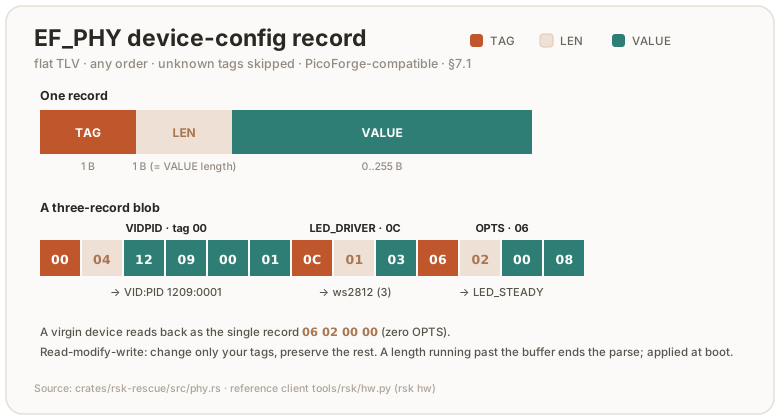
Wire format: a flat sequence of TAG(1) LEN(1) VALUE(LEN) records, any order, all
optional. An unknown tag is skipped; a record whose length runs past the buffer
ends the parse. The firmware applies the record at boot (USB identity + LED
hardware).
A write (CCID WRITE 0x1C §6, or FIDO CONFIG_WRITE 0x0C target 1 §9) is a
read-modify-write merge: only the tags the blob carries are updated; every
untouched tag keeps its stored value. So a host may send just the fields it
changed without wiping the rest, and a tag is cleared only by an explicit
zero/empty TLV. (A host may still do a full read-modify-write for clarity.)
| Tag | Name | Len | Value |
|---|---|---|---|
00 | VIDPID | 4 | VID(BE2) ‖ PID(BE2) |
04 | LED_GPIO | 1 | data-pin GPIO 0..=29 |
05 | LED_BRIGHTNESS | 1 | global channel max 0..=255 |
06 | OPTS | 2 | flags (BE16): WCID 0x1, DIMM 0x2, DISABLE_POWER_RESET 0x4, LED_STEADY 0x8 |
08 | PRESENCE_TIMEOUT | 1 | touch-wait timeout in seconds, bounding the whole ceremony on a button build — the press wait and the release debounce that follows a confirm share it; a trusted-display ceremony may add up to 3 s absorbing a resting finger (0/absent ⇒ firmware default 30 s; a non-zero value below 10 is raised to 10). Matches PicoForge PresenceTimeout. |
09 | USB_PRODUCT | 1..33 | product string + trailing NUL (length includes the NUL). A 33-byte value with no terminating NUL is malformed and leaves the stored string unchanged; an empty value is the explicit clear |
0A | ENABLED_CURVES | 4 | FIDO curve bitmask (BE32) |
0B | ENABLED_USB_ITF | 1 | interface mask: CCID 0x1, WCID 0x2, HID 0x4, KB 0x8, LWIP 0x10 |
0C | LED_DRIVER | 1 | 1 = gpio, 2 = pimoroni, 3 = ws2812 (follows PicoForge LedDriverType) |
0D | LED_ORDER | 1 | RS-Key extension — WS2812 wire order: 0 = rgb, 1 = grb |
0E | LED_NUM | 1 | RS-Key extension — addressable LEDs actually connected (1..=255; 0/absent = the build’s MAX_LEDS). Firmware saturates a value above its compiled MAX_LEDS ceiling. |
0F | USB_MANUFACTURER | 1..33 | RS-Key extension — iManufacturer string + trailing NUL (length includes the NUL). Absent ⇒ the VID-derived default, then the build const. |
Notes for a host implementation:
- Read-modify-write. READ the record, change only your tags, WRITE it back.
This is exactly what
rsk hwdoes (tools/rsk/hw.py). Preserving tags you don’t recognize costs you nothing, but note the device does not:merge_saveoverlays your blob onto the parsed record and re-serializes only the tags this firmware knows, so a tag it does not recognize is dropped at the first write whatever the host sends. - RS-Key-specific tags PicoForge skips as unknown:
0x0B(ENABLED_USB_ITF),0x0E(LED_NUM) and0x0F(USB_MANUFACTURER). RS-Key’s own tools preserve them across a RMW; LED_NUM sets how many daisy-chained addressable LEDs are lit (the binary carries a compile-timeMAX_LEDSceiling and drives the first LED_NUM of it). The rest, including0x08(PRESENCE_TIMEOUT) and0x0D(LED_ORDER), is shared with PicoForge. PRESENCE_TIMEOUThas a floor. The record is host-writable and the touch wait reads it live, so a one-second window could expire in the middle of a press and let the next queued request inherit that same hold. The firmware raises any non-zero value below 10 seconds. The floor is applied at boot, on the way to the wait. The stored record keeps the value as written, so a read-modify-write round-trip is lossless;CONFIG_READ’s effective map (§9) reports the floored value, because that is the window the device actually waits.ENABLED_USB_ITF: absent ⇒ ALL. A mask that would disable every interface the firmware actually builds (CCID | HID | KB) is rejected and falls back to ALL. Otherwise CCID would vanish and the rescue applet that could fix it would be unreachable. Never write a mask without CCID unless you intend that.- A never-written record reads back as the single zero-OPTS TLV
06 02 00 00.
8. Vendor / LED applet — per-status LED color & effects
AID F0 00 00 00 01. CLA 00. Live LED customization (color/brightness/effect
per device status), persisted in flash and applied immediately. Source:
crates/rsk-vendor/src/lib.rs,
firmware/src/led.rs. Reference client:
tools/rsk/led.py.
| INS | P1 | P2 | Request | Response | Purpose |
|---|---|---|---|---|---|
01 | — | — | — | counter (BE4) | INCREMENT test counter, return new value. User-presence-gated (6985 if declined) |
02 | — | — | — | counter (BE4) | GET test counter |
10 | brightness 0..255 | color | steady | status<<4 | [effect[, speed]] opt. | — | SET LED for one status |
11 | 00 | 00 | — | 17-byte config block | GET LED config |
1F | 00/01 | 00 | — | — | REBOOT (warm / BOOTSEL). 01 is user-presence-gated (6985 if declined; see §7) |
INS 12 (CORE1_STATS) and INS 13 (KEYGEN_BENCH) exist only in the measurement
builds that ask for them (--features core1-stats / keygen-bench); a shipped
image answers 6D00, and neither is part of the stable surface.
SET LED 0x10 gating: ungated by default (like the rest of the config surface),
user-presence-gated under strict-config — the FIDO twin
(CONFIG_WRITE/CONFIG_TARGET_LED) is gated there too, so the vendor AID cannot be
used to bypass it.
SET LED 0x10 is idempotent. A request whose resulting 17-byte block already
matches the stored EF_LED_CONF answers 9000 and writes no flash, exactly as the
FIDO twin does. The LED is still applied live, so the two are indistinguishable from
the host; what changes is the flash. Before this, a replayed SET LED appended
28.1 bytes of the main (credential) partition every time — measured over the
device’s own store on the board’s 352-page ring — rising to 117.0 / 203.8 B on a
74.8 % / 85.2 % live ring, where reclaim had to migrate credential records past it.
A record written by an older firmware (a 13/9/3/2-byte layout) is not a match and
is upgraded on the next write. This bounds the replay only: the command stays
ungated by default, so a host that varies the block on every call still churns
those pages, as do the other ungated config writes beside it.
INCREMENT 0x01 gating: user-presence-gated in every build. The applet answers
on both CCID and CTAPHID, so ungated this was a flash-write primitive for anything
that can open either interface — measured at ~390 writes/s, 16 bytes of the counter
partition each. A test hook with no product function should not offer one; the
config-surface writes next to it (SET LED, and the FIDO CONFIG_WRITE twin) stay
ungated by default on purpose, which is a separate decision (§9, strict-config).
GET 0x02 reads and stays ungated. A no-touch build confirms without a button, which
is what tests/01_flash_persistence.py and tests/30_ccid_transport.py run against;
on a button build the CTAPHID caller sees KEEPALIVE(UPNEEDED) until the touch lands.
Touch-status normalization. The awaiting-touch indicator is the only consent
signal on a build without the trusted display, so the EF_LED_CONF codec — not any
one command handler — normalizes it on every decode: the vendor SET LED, the
FIDO CONFIG_WRITE LED target (§9), and the boot reload of the stored record
alike. Four rules, in that order:
color 0(off) on the touch status becomes the default touch colour (yellow).- its
brightnessis raised to8. - a non-zero
speedis raised to2(speed 1makes the breathing effect render an all-black frame every tick while the brightness byte still reads compliant). - the touch colour is the touch status’s alone. Any other status configured in
that colour is reset to its own factory look — whatever its effect, brightness or
speed. Uniqueness deliberately keys on colour rather than on the whole
(effect, color, brightness, speed)quad: brightness and speed are continuous bytes, so a one-unit nudge is byte-unequal and eye-identical; steady mode renders a solid frame for every effect; and on a one-LED boardbounceandflowboth collapse to the same solid frame, so the effect byte carries no signal there.
The give-way case. If the status wearing the touch colour has that colour as
its factory colour, resetting it would not resolve the clash, so the touch
status reverts to its factory look (bounce / yellow) instead. Only boot (red) and
idle/processing (green) can trigger this. A red touch status therefore sticks
only while boot is not red, and a green one only while neither idle nor
processing is green. Yellow is nobody else’s factory colour, which is what makes
the fallback converge: enforcing twice is enforcing once.
What this does not guarantee. Two statuses in different colours can still be
hard to tell apart. The gpio backend has no hue at all — the indicator is lit or
unlit; red, green and yellow are mutually confusable under red-green colour
blindness; and on a one-LED board the effect adds nothing. What separates the
states there is the per-status blink timing (touch 1000/100 ms vs idle
500/500 ms), which is compile-time fixed and cannot be reconfigured — but the
global steady toggle suppresses blinking altogether, and on a single-colour backend
that leaves nothing at all to tell the states apart. A build with the trusted
display remains the strong answer for consent signalling.
So the bytes you write are not always the bytes that render. SET LED 0x10
normalizes before it persists, and GET LED 0x11 always returns what is actually
showing. The FIDO CONFIG_WRITE LED target (§9) stores the block you sent
verbatim and CONFIG_READ echoes that, so after a CONFIG_WRITE read back with
GET LED to see the rendered values.
SET LED 0x10 P2 layout: bits [2:0] = color, bit 3 (0x08) = steady
(solid, no blink, a global toggle), bits [5:4] = status. P1 = per-channel
brightness. The command data field is optional: data[0] sets the status’s
effect, data[1] its speed (0 = the effect’s built-in default). They
are independent: send no data to leave both unchanged, one byte to set only the
effect (the current speed is kept), two bytes to set both.
GET LED 0x11 response (config_block, 17 bytes):
steady(1) | (effect, color, brightness, speed) × 4 for statuses idle,
processing, touch, boot in that order. (block[0] = steady; status s →
effect block[1+4s], color block[2+4s], brightness block[3+4s], speed
block[4+4s].) Read the response length: older firmware returns a 13-byte
(effect, color, brightness) or 9-byte (color, brightness) block. The stride
is (len − 1) / 4.
| Color | Code | Status | Code | |
|---|---|---|---|---|
| off | 0 | idle | 0 | |
| red | 1 | processing | 1 | |
| green | 2 | touch | 2 | |
| blue | 3 | boot | 3 | |
| yellow | 4 | |||
| magenta | 5 | |||
| cyan | 6 | |||
| white | 7 |
Effects (the effect byte, ws2812 backend only; gpio/pimoroni always
use the classic on/off blink). legacy reproduces the original blink; the rest
animate across the connected LEDs and reduce gracefully on a single LED:
| Effect | Code | Effect | Code | |
|---|---|---|---|---|
| legacy (classic blink) | 0 | flow | 3 | |
| vapor (breathing) | 1 | sparkle | 4 | |
| bounce | 2 |
Example. Set the idle status to solid blue at brightness 0x20:
P2 = color 3 | steady 0x08 | status 0<<4 = 0x0B, APDU 00 10 20 0B.
Example. Set touch to yellow bounce at brightness 0x10, speed 0x0F:
P2 = color 4 | status 2<<4 = 0x24, data = effect 2 ‖ speed 0x0F,
APDU 00 10 10 24 02 02 0F.
9. CTAPHID authenticatorVendor (0x41) — seed backup, attestation, audit
A CTAP2 vendor command (command byte 0x41) carrying a CBOR map. This is the
most security-sensitive surface: it can export the device master seed. Source:
crates/rsk-fido/src/vendor.rs, constants in
crates/rsk-fido/src/consts.rs.
Request map: {1: subcommand(uint), 2: subCommandParams(map), 3: pinUvAuthProtocol(uint), 4: pinUvAuthParam(bstr)}.
Keys 3/4 are present only when a PIN is set (see gating).
| Sub | Name | Params (key 2) | Response | Gate |
|---|---|---|---|---|
01 | MSE | {1: COSE_Key, 2: mlkem_ek?} | {1: COSE_Key, 2: ct?} | none (establishes channel) |
02 | BACKUP_EXPORT | — | {1: blob(60)} | MSE + touch + PIN-token; refused if sealed |
03 | BACKUP_LOAD | {1: blob(60)} | — | MSE + touch + PIN-token; refused if soft-locked. With no PIN set it additionally takes a distinct “Replace device seed?” confirmation — the PIN-token half is waived in that state, and a LOAD re-keys every existing credential |
04 | BACKUP_FINALIZE | — | — | touch + PIN-token when a PIN is set (no MSE) |
05 | BACKUP_STATE | — | {1: sealed, 2: has_seed, 3: locked, 4: unlocked} | ungated |
06 | UNLOCK | {1: blob(60)} | — | MSE (the lock key is the auth) |
07 | AUDIT_READ | — | journal window | PIN-token; touch if no PIN |
08 | AUDIT_CHECKPOINT | {1: nonce ≤32} | DEVK signature over chain head ‖ nonce | PIN-token + touch |
09 | ATT_IMPORT | {1: blob(60), 2: DER chain} | — | MSE + touch + PIN-token. With no PIN set it additionally takes a distinct “Replace this identity?” confirmation — the PIN-token half is waived in that state, and an import replaces the identity every later U2F REGISTER signs with |
0A | ATT_CLEAR | — | — | MSE + touch + PIN-token |
0B | ATT_STATE | — | {1: present, 2: sha256(chain)?} | ungated |
0C | CONFIG_WRITE | {1: target(uint), 2: blob(bstr)} — target 0=DEV_CONF, 1=PHY, 2=LED | — | ungated by default; touch + PIN-token under strict-config; no MSE. A write that changes nothing is a no-op: no flash write, no journal entry, and for PHY no reboot latch |
0D | CONFIG_READ | {1: target(uint)} — target 1=PHY, 2=LED | {1: blob(bstr)[, 2: {phy_tag: uint}]} | ungated |
0E | AUDIT_CONFIG | {1: op(uint)} — 0=disable, 1=enable, 2=status | {1: enabled(bool)} | set: PIN-token + touch; status (2): ungated |
Device configuration over FIDO (
CONFIG_WRITE 0x0C)The pcscd-free twin of the CCID device-config writes (§6 WRITE CONFIG and the
§7/§8phy/LED records): a host that cannot reach the CCID interface writes the same config over CTAPHID.targetselects the record:0x00= the management enabled-apps TLV (EF_DEV_CONF, the §6 blob,≤ 64bytes → the sameCTAP1_ERR_INVALID_LENGTH 0x03cap);0x01= the phy record (EF_PHY, §7.1: VID/PID, USB interfaces, LED wiring, presence-timeout; a read-modify-write merge — only the TLV tags in the blob are updated, the rest preserved (the samemerge_savethe CCID path uses), effective on the next boot);0x02= the LED config block (EF_LED_CONF, §8,CONF_LENbytes), persisted and then applied live by the firmware, which reloads the block after a0x41command (the LED atomics are firmware-side;CONFIG_READ 0x02returns the current block, seeded with the build defaults on first boot, so a host can read-modify-write it — verbatim, so it can differ from what renders once §8’s touch normalization applies). No MSE channel. The config is not secret. On the default build this write is ungated (full ykman parity — any USB host process can rewrite it). Building--features strict-configgates it on a physical touch and, when a PIN is set, apinUvAuthTokenwith theacfgpermission (the MAC below): a stronger gate than the CCID path’s presence-only, because CTAPHID is reachable by any unprivileged host process. The write lands in the sameEF_DEV_CONF, so a later CCID READ CONFIG echoes it.Replays and the audit journal. A write whose result equals what is already stored returns
0x00and does nothing at all — no flash write, no journal entry, and forPHYno auto-reboot latch. The comparison is against the merged record forPHY, so a partial blob that changes nothing is also a no-op; an absent or unreadableEF_PHYis never “unchanged”, so a host writing the default values to repair one is not answered0x00with nothing stored.A write that does change something is journalled, and a run of them costs a single ring entry.
CONFIG_WRITEis one of three journalled events an ungated host can drive on demand — the others are agetAssertioncarryingup:falseand a U2FAUTHENTICATEwithP1=0x08, both of which take the spec-mandated silent path — so appending one per call would let any of them evict the 128-entry window. All three coalesce. ForCONFIG_WRITE, when the newest entry is already a config write the device folds into it. The entry keeps itsseq, its timestamp (the first write of the run) and itsaux(the target that opened it), and itsdetailbecomesrepeats(2 LE) ‖ targets(1)— the number of further writes absorbed (saturating) and a1 << targetmask of every record the run touched. A run never folds across a power cycle, so theBOOTentry between two runs is never swallowed.The two silent FIDO events use a different encoding: the entry keeps the
detailof the first occurrence (the rpIdHash shown is the run’s first site) and the count of further folded occurrences is a saturating LEu16in the entry’s trailing two bytes — previously reserved and always zero, so an older build’s entries decode as a single occurrence. That fold scans the whole window, not just the newest entry, so interleaving two silent classes does not defeat it. A gestured assertion never folds. For a host re-checking the chain: a fold changes the head without advancingseq_next, so the sameseq_nextwith a different head is legitimate and is not a tamper signal (start,seq_nextand the epoch are untouched, so the window still folds to the head exactly as before).
CONFIG_READ 0x0DPHY key 2 (RS-Key0x0852+): the PHY read also returns an optional2:map of the boot-effective values a host can’t otherwise know — keyed by phy tag:4= LED GPIO pin,12= LED driver,8= presence timeout (seconds) — resolved to the build default when the record has no override. Tag8reports the window the wait actually uses, i.e. with the 10 s floor of §7.1 already applied. It is display-only (the1:blob stays the raw override record for read-modify-write); absent (empty map) on a headlessled_kind="none"build, and older hosts ignore it.
⚠️ Seed export hands out a normally non-exportable key
BACKUP_EXPORT (0x02)returns the device’s 32-byte master seed (encrypted over the MSE channel). It is gated by a one-time setup window (re-opened only by anauthenticatorReset) and physical touch and, when a PIN is set, apinUvAuthToken. A management tool exposing this must treat it as a destructive-trust operation: clear warning, explicit confirm, and ideally a “show the mnemonic once” flow rather than storing the blob.BACKUP_FINALIZEseals the window. Thefips-profilebuild refuses export entirely.
9.1 The MSE channel (0x41 / 0x01)
Establishes an encrypted channel for the seed-moving subcommands.
- Request
subCommandParams = {1: COSE_Key}where the COSE key is the host’s P-256 public key{1:2, 3:-25, -1:1, -2:X, -3:Y}.XandYare each exactly 32 bytes — a coordinate whose leading zero your bignum dropped is0x02 INVALID_PARAMETER, not left-padded (RS-Key0x089C+; the same rule the clientPIN and hmac-secret COSE parses apply, and what a YubiKey 5.7.4 does). Optional key2= the host’s ML-KEM-768 encapsulation key (1184 B) to make the channel hybrid PQC. - Response
{1: COSE_Key}= the device’s ephemeral P-256 public key (same COSE shape,-2:dx, -3:dy). If the request included an ML-KEM ek, the response adds key2= the 1088-byte ML-KEM ciphertext. - Channel key (32 bytes):
- classical:
HKDF-SHA256(salt="", ikm = ECDH_x(32), info = dev_pub(65)) - hybrid:
HKDF-SHA256(salt="RSK-MSE-PQ-v1", ikm = ECDH_x(32) ‖ ss_mlkem(32), info = dev_pub(65) ‖ ct(1088)) dev_pubis the 65-byte uncompressed device key04 ‖ dx ‖ dy.
- classical:
Blob format (the 60-byte blob in EXPORT/LOAD/UNLOCK/ATT_IMPORT):
nonce(12) ‖ ciphertext(32) ‖ tag(16), ChaCha20-Poly1305 under the channel key
with AAD = dev_pub (65 bytes).
Channel lifetime — the channel is ONE-SHOT: handshake, then immediately run the one subcommand it protects. (RS-Key
0x0866+.) The device holds one channel key per power cycle. Every gated consumer (BACKUP_EXPORT,BACKUP_LOAD,UNLOCK,ATT_IMPORT,ATT_CLEAR,authenticatorConfigAUT_ENABLE) spends it, whatever the outcome — a declined touch or a failed decrypt spends it too — and a secondMSEwhile one is live answers0x30NOT_ALLOWED and drops the channel, so both parties must re-handshake.This is the boundary, not the CID check below it. A CTAPHID channel id is a routing label the sender writes into its own frame header (CTAP 2.1 §11.2.5), so an interloper forges the victim’s CID rather than using its own, and comparing
mse_cidto the request’s channel compares the attacker’s bytes against themselves. Refusing the re-key is what stops a co-resident process re-keying between yourMSEand yourBACKUP_EXPORTand receiving the master seed instead of you. The cost is that such a process can deny you a handshake; it can never redirect one.For clients: run
MSEimmediately before each subcommand, on the same CTAPHID channel (a subcommand arriving on a different CID still answers0x30), and never cache a channel across two operations. If a handshake answers0x30, a previous run died between itsMSEand its subcommand — the refusal has now cleared it, so retry once; a second0x30means another process is squatting. Unchanged on the wire; behaviour since bcdDevice0x0862.
9.2 PIN gating
When a PIN is configured, seed-moving and audit subcommands require
pinUvAuthProtocol (key 3) and pinUvAuthParam (key 4). The param is
HMAC-SHA256(pinUvAuthToken, 0xFF×32 ‖ 0x41 ‖ subcommand ‖ rawSubCommandParams)
and the token must carry the acfg permission (0x20). rawSubCommandParams is
the verbatim CBOR bytes of the key-2 map. Reference flow:
tools/rsk/backup.py.
An omitted pinUvAuthProtocol is 0x14 MISSING_PARAMETER; one this build does
not support is 0x02 INVALID_PARAMETER, and a value of 0 counts as unsupported
rather than omitted (it used to answer 0x14, as did 3 and every other unknown
value). Since bcdDevice 0x0894.
An unsupported one is judged before the algorithm, the extensions and the
remaining options — makeCredential and getAssertion included, where it used
to be judged after all of them, so a request that got two things wrong was told
about the wrong one (bcdDevice 0x08B6). Two things still outrank it, both
because a YubiKey 5.7.4 puts them there:
- the request map’s own shape — keys 1..=4 of
makeCredentialand 1..=2 ofgetAssertionare read in order, and an absent, empty or over-long one is answered before any value is validated; - the option values of §6.1.2/§6.2.2 step 4:
up:falseonmakeCredential, anduv:truewith nopinUvAuthParamon a build without built-in user verification, are0x2C INVALID_OPTIONwhateverpinUvAuthProtocolsays.options.rkis not in that class and loses to the protocol, on that card and here.
10. Worked examples
All bytes hex; → shows the response (status word omitted when 9000).
Identify the device (Management DeviceInfo):
SELECT  00 A4 04 00 08 A0 00 00 05 27 47 11 17 00
READ    00 1D 00 00 00
→  <len> 01 02 023B 02 04 <serial> 04 01 01 05 03 050704 03 02 023B 08 01 80 0A 01 00
Read the phy record (Rescue):
SELECT  00 A4 04 00 08 A0 58 3F C1 9B 7E 4F 21 00
→  01 02 08 06 <8-byte serial>            # identity handshake
READ    80 1E 01 00 00
→  <phy TLV blob>                          # e.g. 06 02 00 00 on a virgin device
Switch USB identity to 1209:0001 (phy RMW): read the blob, upsert tag 00
with 12 09 00 01, write back:
WRITE   80 1C 01 00 <Lc> <…00 04 12 09 00 01…> 00
REBOOT  80 1F 00 00 00
Set processing-status LED to red, brightness 64 (Vendor/LED):
SELECT  00 A4 04 00 05 F0 00 00 00 01 00
SET     00 10 40 11        # P1=0x40 brightness, P2 = color 1 | status 1<<4 = 0x11
Read backup state (CTAPHID 0x41): CTAP2 message 41 A1 01 05
(0x41 + CBOR {1: 5}) → on a fresh provisioned device
00 A4 01 F4 02 F5 03 F4 04 F4 (status 00, then CBOR
{1:sealed=false, 2:has_seed=true, 3:locked=false, 4:unlocked=false};
F5=true, F4=false).
11. Integration notes for PicoForge
- The phy record (§7.1) is your existing PicoForge config path. Same TLV
layout, same
LedDriverTypenumbering. The differences to handle: the Rescue AID isA0 58 3F C1 9B 7E 4F 21(not the upstream one), the Rescue CLA is0x80, and tag0x0D(LED_ORDER) is an RS-Key extension you can skip on read. You need not re-send unmodelled/untouched tags: the phy write is a merge (§7.1), so omitting a tag no longer wipes it — send only the fields you changed. - Hardware config over FIDO (no PC/SC) is supported: PicoForge’s legacy
hardware-config path. Send
authenticatorConfig(CTAP0x0D) with subCommandvendorPrototype(0xFF) and subCommandParams{1: vendorCommandId(u64), 3: value(uint)}, gated by anacfgpinUvAuthToken (no touch). getInfo’sauthenticatorConfigCommands(0x1F) lists0xFFandvendorPrototypeConfigCommands(0x15) enumerates the IDs below, so the arm and its commands are both detectable without probing — §6.11.3 ties the two, so a build that hides one hides both. That array is the whole vendor arm, not only its hardware half —0x0e6841934e719be7is the enterprise-attestation RP list (§5), which takes an rpId array at key 4 and writes no hardware; treat an unrecognised id as one you do not drive. The phy IDs, the ones PicoForge writes, set the phy record and take effect on the next boot:PhysicalVidPid 0x6fcb19b0cbe3acfa(value(vid<<16)|pid),PhysicalLedGpio 0x7b392a394de9f948,PhysicalLedBrightness 0x76a85945985d02fd,PhysicalOptions 0x269f3b09eceb805f(bitmask0x2dimmable /0x4disable-power-reset /0x8led-steady — all three are honoured: dimmable gates the global boot-brightness override, led-steady forces a solid LED, and disable-power-reset — clear by default — lets a FIDO phy write auto-reboot so the change applies without a replug). Product name, touch-timeout, LED driver and curves stay Rescue-only. RS-Key reports firmware5.x(< 7), so PicoForge enables its legacy hardware-config path. (RS-Key’s ownrskuses the CTAPHID0x41CONFIG_WRITE/READpath instead, see §9, which also covers those extras.) - Applet enable/disable is the Yubico-compatible Management applet (§6),
identical to how you’d configure a YubiKey’s USB applications — and enforced:
a disabled application’s applet stops answering (see §6,
USB_ENABLED). - Version-gate on the Rescue SELECT identity (
01 02 08 06 …, §7) and the Management SELECT version string. Treat unknown phy tags /0x41subcommands as skippable, not errors. - Keep the dangerous surface behind explicit confirmation: the OTP fuse burns (§7), BOOTSEL reboot (§7/§8), and seed export (§9). Consider not exposing the fuse burns at all in a general management UI.
- Reference client:
tools/rskis a complete, runnable implementation of everything here:ccid.py(transport),ctaphid.py(CTAP),hw.py(phy),led.py(LED),backup.py(0x41),status.py/inventory.py(DeviceInfo). When in doubt, match its bytes.